As an Amazon Associate this site earns from qualifying purchases.
Quick Picks: Replacement Lock Sets to Verify
| Product | Published details | Main unknown | Price |
|---|---|---|---|
| FJMQHU 2 Pieces Car Roof Box Locks DIY Upgrade Compact (B0FVXXVF7H) | Zinc alloy; two cylinders and two keys; 4.4 x 2.2 x 3.2 cm body | Approved box models and full mounting requirements | Check Price on Amazon |
| Okiyakusama 2Pcs Car Roof Box Locks Universal Easy to Install (B0FVYJFTVN) | Zinc alloy; two cylinders and two keys; 4.4 x 2.2 x 3.2 cm body | Approved box models and full mounting requirements | Check Price on Amazon |
Disclosure: We earn a small commission from qualifying Amazon purchases at no extra cost to you.
Last Updated: September 2026
If a roof box lock will not operate normally, stop forcing it and use the exact box manufacturer's troubleshooting or authorized service procedure. The symptom alone does not establish whether the problem is the key, cylinder, latch or another component. Do not drive with a carrier whose lid cannot be secured as required.
This guide compares the published details of two replacement lock sets. It does not provide a model-independent drilling, extraction, lubrication or lid-manipulation procedure. A lock advertised as universal and an overall body measurement do not establish that it fits your box.
No one at this site fitted, opened or tested these locks. The product details come from their verified Amazon records and listing feature bullets retrieved September 6, 2026.
These sets are candidates for further compatibility checks. The matching published dimensions and package counts do not establish interchangeability, approval for an unbranded box, or a shared key between either set's cylinders.
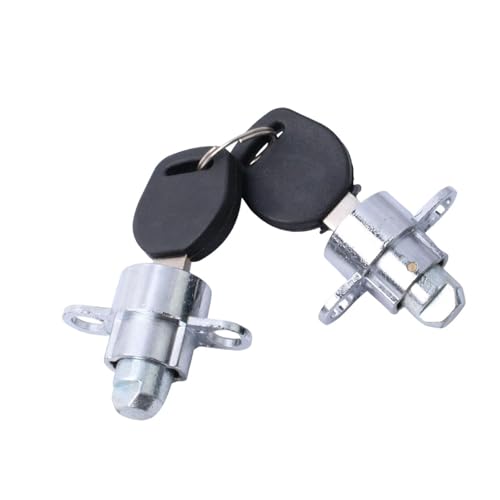
- 【Easy Install 】 Car Roof Box Lock is Easy to install and use, providing a reliable locking solution to keep your belongings on the road
- 【Size】Compact size of 4.4 x 2.2 x 3.2 cm ensures easy installation without taking up extra space
What to Do When a Lock Is Stuck
- Identify the exact equipment. Find the box model and available lock or key identifiers. Use the manufacturer's approved identification method; do not disassemble a stuck mechanism just to obtain a measurement.
- Follow the model's instructions. Use only the troubleshooting steps the box maker approves for that lock and latch. The replacement-part listings below supply no procedure for opening your carrier.
- Avoid improvised treatments. Do not press, rock or heat the lid or mechanism, apply compressed air, add a lubricant, or drill or extract the cylinder based on a generic guide. Any such work needs the exact equipment's approved procedure or an authorized service professional.
- Arrange service if operation remains abnormal. Contact the manufacturer, an authorized service provider or a qualified locksmith who can confirm the appropriate method for the exact box.
- Verify the complete closure before use. After service, follow every required lock, latch and mounting check. A working key by itself does not verify the whole carrier installation.
Lost Keys and Replacement Parts
Start with the box manufacturer and the exact model information. Ask whether an approved replacement key, core or service procedure is available. Losing a key does not establish that drilling or replacing a cylinder is the only option.
For an unbranded or discontinued box, confirm replacement options with an appropriate service provider. A generic listing's “universal” label is not approval for that box. Do not purchase a set solely because its overall body size resembles the old part.
For a keyed-alike system, including a box advertised with Thule One-Key compatibility, obtain the manufacturer's confirmation of the exact core, key arrangement and installation procedure. The two records reviewed here do not establish compatibility with Thule or any other proprietary system.
FJMQHU 2 Pieces Car Roof Box Locks DIY Upgrade Compact
The FJMQHU record for B0FVXXVF7H describes a universal lock-cylinder assembly intended for rooftop luggage boxes. It states zinc-alloy construction and a package containing two keys and two cylinders. The listed body size is 4.4 x 2.2 x 3.2 cm.
That is an overall size description, not a published cutout, shank diameter, lid-thickness range, cam geometry or retention specification. Ask the box maker or service provider to confirm the full replacement requirements and whether this exact part is approved. A ruler comparison alone cannot establish a working installation.
The seller describes easy installation and enhanced security, but supplies no security grade, corrosion-test result or verified service-life figure. The record also does not state whether both cylinders operate on one key. Treat the package and material as documented features, with fit and performance still to confirm.
Consider it only for an approved application. Two cylinders in the package do not guarantee that both should be replaced, that a two-lock lid will use one key, or that a spare cylinder solves a future locked-box incident.
Okiyakusama 2Pcs Car Roof Box Locks Universal Easy to Install
The Okiyakusama record for B0FVYJFTVN also states zinc alloy, two keys, two cylinders and a 4.4 x 2.2 x 3.2 cm body. It describes a universal assembly for rooftop luggage boxes and markets installation as easy.
Those details match the broad descriptions in the FJMQHU record, but they do not establish identical cams, retention hardware, key cuts or approved applications. Obtain the box maker's full requirements and exact-part approval before comparing availability or price.
The supplied listing gives no attack-resistance grade or verified corrosion or durability test. It also does not state that its two cylinders share a key. A spare uninstalled cylinder cannot be assumed to provide access to a carrier locked with another cylinder.
Consider it only when compatibility and the approved service method are confirmed. The package count describes what the seller lists; it is not an installation plan for your particular lid.
Checks Before Ordering a Replacement
- Obtain the exact box and lock identification and the manufacturer's approved replacement specification.
- Confirm every relevant mounting and operating requirement, including cutout, shank, lid thickness, cam and retention details where the manufacturer requires them. Neither listing supplies that complete information.
- Confirm the key arrangement, package contents and whether replacing one or multiple components is appropriate for your model.
- Follow the approved service method, required tools and final closure checks. Do not infer a procedure from the seller's “easy installation” phrase.
- Compare current price and stock only after those requirements are met. Matching overall dimensions alone is not an adequate purchasing criterion.
Care and Prevention
Follow the box and lock makers' specific inspection, cleaning and maintenance schedules. The records used here do not authorize a particular lubricant, solvent, air-cleaning method, temperature treatment or operating interval. A product sold for locks may still be unsuitable for a particular mechanism.
Keep replacement-key information according to the manufacturer's instructions and your own security needs. Inspect abnormal operation using the approved procedure. Do not force a latch into engagement or drive with an unresolved closure problem.
Frequently Asked Questions
The symptom alone does not establish a cause. Use the exact model's troubleshooting instructions or authorized service. These product listings provide no diagnosis or evidence that a particular remedy will work.
Can I open the box without the key?
Ask the box manufacturer or an appropriate authorized service provider about the exact model. The record does not establish that removal or drilling is required, and this guide cannot authorize a generic opening procedure.
Does “universal” mean either replacement set will fit?
No specific box approval is established here. Both sets publish a 4.4 x 2.2 x 3.2 cm body, but neither supplies the complete mounting and operating requirements. Confirm the exact approved part before purchase.
Are the two cylinders keyed alike?
Neither supplied record states that. Each lists two cylinders and two keys, so confirm the arrangement with the seller and box maker if one-key operation matters.
Which lubricant should I use?
Use only a product and method expressly approved for the exact lock and carrier. The supplied replacement-lock records do not identify one; do not apply compressed air or another treatment based on these listings.
How do I replace a Thule One-Key core?
Use Thule's instructions and approved part for the exact carrier and lock configuration. These generic replacement records provide no Thule compatibility evidence or core-change procedure.
Can I drive while the latch is jammed?
Do not drive with a carrier that cannot be secured according to its manufacturer's requirements. Arrange approved service and complete the required checks before use.
Final Verdict
Resolve the operating problem with the exact box maker's guidance first. If replacement is needed, choose a manufacturer-approved part and service procedure. The FJMQHU and Okiyakusama sets have documented materials, body dimensions and package counts, but neither record establishes fit for your box or a verified security upgrade.
Sources & Methodology
The comparisons use the Amazon Creators API verified product records and full listing feature bullets for B0FVXXVF7H and B0FVYJFTVN, retrieved September 6, 2026. No lock was installed, opened, measured or physically tested by this site. Missing fit and performance information remains unknown.
For general consumer safety and recall information, see the U.S. Consumer Product Safety Commission. USA.gov consumer protection resources provide general consumer guidance. These sources do not supply model-specific lock service instructions.